Sunday, 7 February 2016

SYMPTOMES AND CURE FOR LEIOMYOMA

Leiomyomas of the uterus are one of the most common pathologic abnormalities of the female genital tract. Their occurrence increases with age, and they are found in 20–50% of women older than 30 years. Although found elsewhere in the body, leiomyomas most frequently occur in the myometrium. Uterine leiomyomas are commonly referred to as myomas, fibromyomas, or “fibroids” because of their firm, fibrous character and high content of collagen.

Leiomyomas of the uterus are the most common indication for hysterectomy in the United States. Approximately 175,000 hysterectomies are performed annually for leiomyomas. Uterine leiomyomas result in masses associated with a variety of gynecologic problems, the most prominent of which are the asymptomatic pelvic mass or abnormal vaginal bleeding.

The last two decades have seen rapid advancements in the diagnosis and treatment of uterine leiomyomas. The introduction of pelvic ultrasonography sonohysterography, hysteroscopy, and magnetic resonance imaging (MRI) have made it possible to detect small myomas not clinically suspected as a cause of abnormal bleeding. It is also possible to make a definitive diagnosis of a pelvic mass as a uterine myoma short of performing laparotomy or laparoscopy. Understanding the relation of sex steroid hormones and uterine leiomyomas has provided the foundation for using gonadatropin-releasing agonists (GnRH), which have facilitated treatment of leiomyomas by hysteroscopy, laparoscopy, and the liberal use of vaginal hysterectomy. With the introduction of the antiprogesterone RU486 and other drugs that can be used in lieu of surgery, the 21st century will be marked by dramatically new treatments of leiomyomas of the uterus.

SYMPTOMS
Uterine myomas are common, most are asymptomatic and require no treatment. Predominantly intramural or subserous, they are typically found in the highly screened U.S. population as unsuspected pelvic masses at the time of an annual examination and Pap smear.
Patients are usually between 30 and 50 years old. In the past, indications for intervention for asymptomatic uterine leiomyomas included uterine size, inaccessible ovaries, facilitation of estrogen replacement, and a rapid change in uterine size. A review of the literature does not support surgical intervention for uterine leiomyomas based on size alone. According to Mayer and Shipilov, normal ovaries that are not identified by ultrasonography can be differentiated from uterine leiomyomas on MRI, allowing exclusion of ovarian tumors.7 The addition of hormone replacement therapy in standard doses does not appear to provide sufficient amounts of estrogen or progesterone to cause uterine growth. Even the age-old accepted theory of a “rapidly enlarging uterus” has been challenged as an indication for intervention for the asymptomatic leiomyoma. Parker and coworkers reviewed the medical records of 1332 women admitted between 1988 and 1992 for surgical management of uterine leiomyomas. They found no correlation between rapid uterine growth and uterine sarcoma.8

Common symptoms associated with leiomyomas are menorrhagia, pelvic pressure or pain, and reproductive symptoms. The most common symptom associated with leiomyomas is menorrhagia. The cause of leiomyoma-associated menorrhagia is unknown. Ulceration of a submucous myoma and compression of venous plexus or adjacent myometrium and endometrium by intramural myoma have been postulated.9 Rarely, fibroids may present as a result of pressure on neighboring organs, such as urinary frequency or urinary obstruction secondary to urethral obstruction. Rectal symptoms also are rare, but blockage or irritation of the rectum and rectal sigmoid can occur. Acute pain associated with a low-grade fever and uterine tenderness may be observed with degeneration of leiomyomas or with torsion or a pedunculated subserous myoma.

The major clinical issues involved with leiomyomas of the uterus include the differential diagnosis, management of the asymptomatic pelvic mass, and appraisal of the role of the fibroid in various clinical problems such as abnormal bleeding, pain, infertility, and pregnancy. A review of current approaches to the differential diagnosis and treatment options for leiomyomas is appropriate.
TREATMENT
The problems associated with bleeding myomas are related primarily to anemia, but the myomas can also create difficulties in maintaining an acceptable lifestyle because of the problems of pelvic discomfort. The submucous myoma particularly can be the cause of major hemorrhage and produce emergency situations. Intramural fibroids and a distorted endometrial cavity can produce a similar picture and force intervention.
The clinical problems produced by the mass of the myomatous uterus usually are not observed until the mass rises out of the pelvis. In nonpregnant states, the mass may cause ureteral obstruction, bladder and rectal pressure, pelvic pain, and if the mass extends to the umbilicus or above, diaphragmatic pressure. Rarely, when the pedunculated subserous myomas twist and causes acute or chronic symptoms or marked abdominal protuberance, surgical intervention is warranted.

Benign degeneration of the myoma is usually caused by avascular necrosis. It is principally seen during pregnancy, when it should be treated symptomatically. Malignant degeneration results in sarcoma, which occurs in 0% to 5% of cases. Sarcomas arising de novo in normal uteri usually tend to be more aggressive. Changes in size, especially those associated with vaginal bleeding a postmenopausal woman, are signs of possible malignant degeneration.

Major advances in the treatment of symptomatic fibroids have created treatment options. The principal treatments for uterine myomas are control of the symptoms after a benign diagnosis is established. The options for treatment of symptomatic fibroids are medical management and surgery.

Medical Management

The management of symptomatic uterine myomas has traditionally involved surgery. However, the introduction of GnRH agonists in the 1980s offered temporary relief to women with myomas who do not desire surgery and are approaching menopause.18

The use of a GnRH agonist produces a hypoestrogenic state, which leads to a median reduction in uterine volume of approximately 50%. The maximal effect is seen after 12 weeks of therapy, with no further reduction in uterine size observed between 12 and 24 weeks of therapy. Unfortunately, rapid regrowth of myomas after therapy and side effects related to the hypoestrogenic state such as bone loss and hot flashes have limited the usefulness of the GnRH agonists.

To overcome the side effects of long-term GnRH therapy and maintain decrease in uterine size, Friedman and coworkers proposed an “add-back” regimen of estrogen and progesterone in small doses.19 Early reports with add-back therapy appear promising, but the high cost ($300.00/month) associated with GnRH agonist with estrogen and progesterone have limited this approach. The ultimate place for GnRH agonist therapy may be as a presurgical treatment before myomectomy or hysterectomy.

The GnRH agonist can cause a cessation of menses, allowing severe anemia to be corrected before surgery and avoiding preoperative blood transfusions. It also been shown to reduce operative blood lose. Preoperative GnRH also opens the possibility for converting some cases of abdominal hysterectomy into a vaginal hysterectomy through reduction in uterine mass.

Surgical Management


The key factors governing the surgical options are the patient's age, fertility status, and reliability; the impact of fibroids on surrounding organs; and attendant medical, surgical, or anesthetic risks that may complicate surgical treatment. If fertility is a consideration and the patient has major symptoms, myomectomy is the procedure of choice. Myomectomy should be preceded by a hysterosalpingogram to determine the location and patency of the fallopian tubes and to screen for submucous myomas. Extensive and aggressive myomectomy runs the risk of resulting in emergency hysterectomy. The use of uterine tourniquets and vasopressin has reduced the amount of blood loss during myomectomy. Dillon reported that, with the use of vasopressin, 72% of patients undergoing myomectomy did not need blood products.20 Other complications associated with abdominal myomectomy are pelvic adhesion and bowel obstruction. In comparing the overall morbidity associated with myomectomy with that of hysterectomy, Iverson found no difference.21

A patient undergoing myomectomy should understand that the procedure is a treatment for fibroids, not a cure. There is a 15% recurrence rate of myomas after myomectomy and a 10% reoperation rate.

Dubuisson first reported myomectomy under laparoscopic control.22 Technical innovations such as electric morsulators (Karl Stortz) and simplified suturing techniques have made this procedure more feasible. Laparoscopic myomectomy can be offered as an alternative to abdominal myomectomy in selected cases (i.e. with a single myoma smaller than 6 cm) and should only be attempted by experienced laparoscopic surgeons. It has been suggested that adequate closure of the myometrium after laparoscopic myomectomy is difficult and may account for uterine rupture during pregnancy after undergoing a laparoscopic myomectomy.

Saturday, 6 February 2016

UN warns against laws restricting pregnancy

The UN High Commissioner for Human Rights, Zeid Al Hussein, disclosed this in a statement made available to newsmen on Friday in New York.
  • Published: 
Tropical Tonga declares Zika outbreak after five cases confirmed
The United Nations (UN) has called for the repeal of laws and policies that restrict access to sexual and reproductive health services in contravention of international standards.
The UN High Commissioner for Human Rights, Zeid Al Hussein, disclosed this in a statement made available to newsmen on Friday in New York.
The statement said that the UN position was in response to advice to women by some governments to delay getting pregnant due to the possible link between the rampaging Zika virus and neurological disorders affecting newborns.
According to the statement, upholding women’s human rights was essential if the response to the Zika health emergency would be effective.
``Clearly, managing the spread of Zika is a major challenge to governments in Latin America.
``However, the advice of some governments to women to delay getting pregnant ignores the reality that many women and girls simply cannot exercise control over when they become pregnant.
``The circumstance is made more difficult in environment where sexual violence is so common,’’ the statement said.
The statement noted that ``in situations where sexual violence is rampant and sexual and reproductive health services are unavailable, efforts to halt Zika crisis will not be enhanced by stopping women from getting pregnant’’.
The statement stressed that, amid the continuing spread of the virus, authorities must ensure that their public health responses were pursued in conformity with human health-related rights obligations.
``Upholding human rights is essential to an effective public health response.
``This requires that governments ensure that women, men and adolescents have access to comprehensive and affordable quality sexual and reproductive health services and information, without discrimination.
``Health services must be delivered in a way that ensures the woman’s informed consent, respect for her dignity and the guarantee of her privacy.
``Laws and policies that restrict her access to these services must be urgently reviewed in line with human rights obligations in order to ensure the right to health for all in practice,’’ it stated.
The News Agency of Nigeria (NAN) reports that the World Health Organisation (WHO) has declared a public health emergency on the spread of the virus.
The Organisation had said that causative link between Zika and microcephaly - babies born with abnormally small heads and underdeveloped brain- and Guillain-BarrĂ© Syndrome (a neurological condition), is still under investigation.

101 Die From Lassa Fever In Nigeria, Says NCDC

The Nigeria Centre for Disease Control (NCDC) has disclosed that the growing Lassa Fever outbreak in Nigeria has killed a total of 101 people.
Statistics from NCDC show that reported cases of the haemorrhagic disease — both confirmed and suspected — stand at 175 with a total of 101 deaths since August.
According to the NCDC, deaths from the virus were recorded in Abuja, Lagos, and 14 other states.
The outbreak of Lassa Fever was only announced in January, months after the first case of the disease happened in August, with subsequent deaths reported in 10 states, including Abuja.
In 2015, 12 people died in Nigeria out of 375 infected, while in 2012 there were 1,723 cases and 112 deaths, according to the NCDC.

In neighbouring Benin Republic, at least nine people have died in a Lassa outbreak, with a total of 20 suspected cases.

Tuesday, 2 February 2016

ZIKA VIRUS: Prevention!


    No vaccine exists to prevent Zika virus disease (Zika).
    Prevent Zika by avoiding mosquito bites (see below).
    Mosquitoes that spread Zika virus bite mostly during the daytime.
    Mosquitoes that spread Zika virus also spread dengue and chikungunya viruses.

When traveling to countries where Zika virus or other viruses spread by mosquitoes are found, take the following steps:


    Wear long-sleeved shirts and long pants.
    Stay in places with air conditioning or that use window and door screens to keep mosquitoes outside.
    Sleep under a mosquito bed net if you are overseas or outside and are not able to protect yourself from mosquito bites.
    Use Environmental Protection Agency (EPA)-registered insect repellents. All EPA-registered insect repellents are evaluated for effectiveness.
        Always follow the product label instructions
        Reapply insect repellent as directed.
        Do not spray repellent on the skin under clothing.
        If you are also using sunscreen, apply sunscreen before applying insect repellent.
    If you have a baby or child:
        Do not use insect repellent on babies younger than 2 months of age.
        Dress your child in clothing that covers arms and legs, or
        Cover crib, stroller, and baby carrier with mosquito netting.
        Do not apply insect repellent onto a child’s hands, eyes, mouth, and cut or irritated skin.
        Adults: Spray insect repellent onto your hands and then apply to a child’s face.
    Treat clothing and gear with permethrin or purchase permethrin-treated items.
        Treated clothing remains protective after multiple washings. See product information to learn how long the protection will last.
        If treating items yourself, follow the product instructions carefully.
        Do NOT use permethrin products directly on skin. They are intended to treat clothing.

Sick with Chikungunya, Dengue, or Zika? Protect yourself and others from mosquito bites during the first week of illness.

If you have Zika, protect others from getting sick

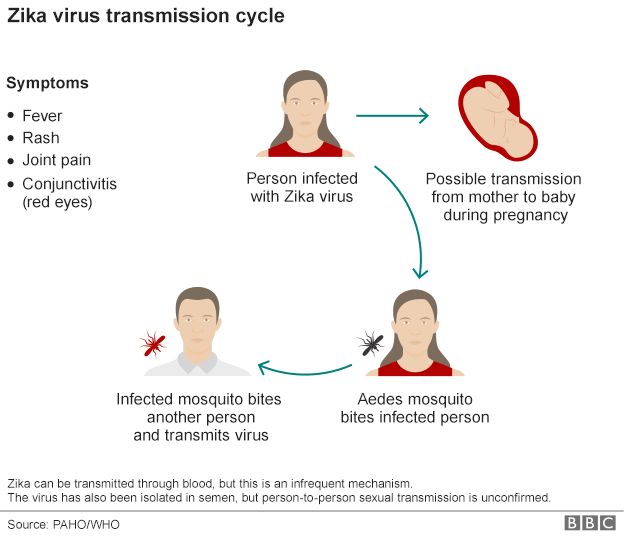
    During the first week of infection, Zika virus can be found in the blood and passed from an infected person to another mosquito through mosquito bites. An infected mosquito can then spread the virus to other people.
    To help prevent others from getting sick, avoid mosquito bites during the first week of illness.

Monday, 1 February 2016

Another Big One-ZIKA VIRUS

Zika virus (ZIKV) is a member of the Flaviviridae virus family and the Flavivirus genus, transmitted by daytime-active Aedes mosquitoes, such as A. aegypti.


In humans, the virus causes a mild illness known as Zika fever, Zika, or Zika disease, which since the 1950s has been known to occur within a narrow equatorial belt from Africa to Asia. In 2014, the virus spread eastward across the Pacific Ocean to French Polynesia, then to Easter Island and in 2015 to Mexico, Central America, the Caribbean, and South America, where the Zika outbreak has reached pandemic levels.
Aedes aegypti

Transmission

 Zika virus is transmitted by daytime-active mosquitoes and has been isolated from a number of species in the genus Aedes, such as A. aegypti, and arboreal mosquitoes such as A. africanus, A. apicoargenteus, A. furcifer, A. hensilli, A. luteocephalus and A. vitattus. Studies show that the extrinsic incubation period in mosquitoes is about 10 days. Zika virus can migrate between humans through sexual contact and it can also cross the placenta, affecting an unborn fetus. A mother already infected with Zika virus near the time of delivery can pass on the virus to her newborn around the time of birth, but this is rare.
The vertebrate hosts of the virus are primarily monkeys and humans. Before the current pandemic, which began in 2007, Zika virus "rarely caused recognized 'spillover' infections in humans, even in highly enzootic areas".

symptoms 

Common symptoms of infection with the virus include mild headaches, maculopapular rash, fever, malaise, conjunctivitis, and joint pains. The first well-documented case of Zika virus was described in 1964; it began with a mild headache, and progressed to a maculopapular rash, fever, and back pain. Within two days, the rash started fading, and within three days, the fever resolved and only the rash remained. Thus far, Zika fever has been a relatively mild disease of limited scope, with only one in five persons developing symptoms, with no fatalities, but its true potential as a viral agent of disease is unknown.

As of 2016, no vaccine or preventative drug is available. Symptoms can be treated with rest, fluids, and paracetamol (acetaminophen), while aspirin and other nonsteroidal anti-inflammatory drugs should be used only when dengue has been ruled out to reduce the risk of bleeding.

Excerpt from wikipedia and BBC(https://en.wikipedia.org/wiki/Zika_virus )

Saturday, 30 January 2016

Lassa Fever, Deadly as Ebola

 
FOR Nigeria, it never rains but pours. Having overcome the dreaded Ebola disease that broke out in the country in 2014, Nigeria is now faced with another hydra headed monster, Lassa fever that has been described in some quarters as a dreaded viral assassin. The disease has claimed over 80 lives within a space of 12 weeks.
Fuka, a remote village in Muyan Lo­cal Government Area of Niger State, was where recent cases of Lassa fever were first reported, late last year. By the time it was discovered, 16 people had already died from the virus. It then spread to Bauchi and Kano states, be­fore hitting 15 other states including Abuja, the Federal Capital Territory.
Having sent over 80 people to their early graves with more than 239 others on watch list, the manner at which it has spread to over 80 local governments and 18 states, has made it a national emergency.
According to the Minister of Health, Prof Isaac Adewole, the affected states are Niger, Bauchi, Kano, Taraba, Riv­ers, Ondo, Oyo, Edo, Lagos, Plateau, Gombe, Delta, Nasarawa, Ebonyi, Eki­ti, Kogi and Zamfara, and the Federal Capital Territory.
The fever, according to the World Health Organisation (WHO), is an acute viral haemorrhagic illness caused by Lassa virus, which is transmitted to humans through contact with food or household items contaminated with the excreta or urine of infected multi-mammate rats.
This specie of rats is a common sight in both rural and urban areas in Nigeria. In some parts of the country, especially in Benue State, it is a delicacy.
In order tackle the problem that has become a national emergency, various measures have been taken by the fed­eral and state governments as well as individuals and organisations.
Penultimate Friday, the Federal Gov­ernment launched a Public call centre at Nigeria Centre for Disease Control (NCDC) that will serve the country on all public health emergencies.
Launching the centre, Professor Ad­ewole reiterated the determination of the Buhari administration to provide access to health care information that will keep diseases away from Nigeria. He urged Nigerians to avail them­selves of the opportunity provided by the centre to help government prevent diseases, especially Lassa fever out­break.
The minister called on citizens who have symptoms of the fever to call any of the ten (10) numbers: 097000010 to 19 from anywhere in the country and that such calls will be directed to the appropriate state epidemiologists or refer them to the nearest health facil­ity. The minister also said, where pos­sible, patients could be picked-up from their locations and taken to the nearest health facility. He assured the public that anyone that uses the call facility would certainly receive help.
Adewole also called on all the states to strengthen their surveillance sys­tems, report all cases and collaborate with the Federal Ministry of Health in the successful implementation of the Multi-Sectoral Response Strategy to fighting Lassa fever.
In the same vein, the Environmental Health Officers Association of Nigeria (EHOAN), Lagos State Chapter, on Monday said that it had destroyed no fewer than 4,400 rats at six major mar­kets in the state under its de-rat market programme. Its president, Mr. Samuel Akingbehin, said that his association carried out the exercise at Onigongbo, Oshodi, Oke-Odo, Ikotun Idanwo, Ojuwoye and Mile 12 markets.
He said that de-rating the markets was part of the association’s efforts to curb the spread of Lassa fever in the state. “The exercise is strategic in our effort towards the prevention of com­municable diseases, This,” he said, was part of efforts by the public and relevant agencies to de-rat markets which was reponsible for the Lassa fe­ver that had broken out in many states.
Akingbehin appealed to traders from across the state to show under­standing towards the efforts of the association to rid the markets of rats and rodents. He said that the plan was to de-rat markets in one local govern­ment area per day starting from 5p.m. The association decided on the time to allow traders and buyers transact their legitimate businesses. ­
“We also decided to put the exercise in the evening due to the nocturnal nature of rodents and our members had recorded successes in the markets visited till date. It took us about three hours to cover Oshodi market when our mem­bers went there for the exercise. Today, Mon­day, we will be visiting Suru-Alaba Market in Orile-Ifelodun LCDA by 5pm with about 400 EHOs to de-rat it.
“We are still calling on all other executive secretaries of the local government areas to as­sist us toward the elimination of rodents in our markets and our environments,’’ he said.
Ogun State is also one of the states that has shown some proactive steps in this direc­tion. The state governor, Mr. Ibikunle Amosu, recently designated three hospitals to handle cases of Lassa fever just as the government an­nounced emergency numbers, which residents could call should there emerge any case.
In the same vein, Benue State government has banned eating of rats. The governor, Samu­el Ortom, gave the directive, and explained that it became necessary, as the state has recorded a case of the virus. Rat is a delicacy popular among the people of the state.
Niger, Bauchi, Taraba, Kano, Nasarawa and Plateau states, where the ailment are believed to be prevalent have not taken up the gauntlet.
Some households in Lagos, which could not afford the cost and services of fumigators bought rat poisons in large quantities and drop them at strategic locations where the rodents are found. Some compounds which could, have employed professional fumigators to eradicate rodents in their environments.
Saturday Sun findings revealed that many are not seeing the virus as a se­rious threat even when it has claimed more lives than Ebola Virus Disease.
This, according to one of the man­ufacturers of rat poisons, who have introduced varieties of rat poisons in the market to eradicate rodents in the homestead, Jossy Chukwu, the case of Lassa fever was an opportunity for business boom, but his organisa­tion has not noticed any difference in sales. “Rat killer is a very impor­tant product for people to buy. Even before the issue of Lassa fever came up, many people knew that rat is very dangerous to man and his property. In so many homes today, aside sickness, rats have caused a lot of agonies by eating up certificates and other im­portant documents. Secondly, if rat enters your room, it will make you uncomfortable and sleepless”, he stated.
He said that another reason people kill rats is because they see them as instruments of witches and wizards. “We have observed that some people avoid rats, not because they spread diseases, but because they see rats as evil. So, they do everything possible to chase rats away from their homes always. That is why our business is steady.”
Chukwu was optimistic that with the outbreak of Lassa fever in Nigeria, rat poison business will boom while expressing his readiness to push more of the products to the market. “I am not sure that many people are aware that Lassa fever is caused by rats. But whenever they are aware of the dan­gers of the disease, I am sure, they will not fail to buy rat killers. And, by so doing, we would make more sales”.
Another producer, David Ohake explained that the outbreak of the dis­ease has not increased sales at the mo­ment, but has made production of rat killer become tedious, as efforts are being made to ensure that the products are available in the markets for people to buy. “We have not started making extra sales yet since the case of Lassa fever came up. But we are putting ex­tra efforts to see that the issue of Lassa fever is dealt with by making rat kill­ers available, everywhere and at any time they are needed”, he added.
Ohake also explained that corpo­rate organisations buy the rat killers due to the damages rats have done to their vital documents. “I have some customers from corporate oganisa­tions who always come to buy rat kill­ers in large quantities for use in their offices to keep their documents free from rats.”
He was also hopeful that as soon as more people become aware of the disease, rat killer business will boom.
A marketer at Iya Abiye Street, Il­aje Otumara, Ebute-Metta Lagos, Mr Austin Obisere said sales have not in­creased as a result of the disease, not­ing that an active rat killer that is sold between N200 and N500 depending on the brand remains same.
He stated the reason business is moving in the area is because there are so many rats around due to the presence of the lagoon. “Our sales are not based on the fear of Lassa fever because there is low awareness on the disease. The truth is that a lot of people hate rats and do not want to see them.”
Obisere expressed optimism “that now the new disease is said to be kill­ing many people, there is hope for more sales to be made.”
Another marketer at Ilaje area in Ebute –Metta, Mr. Solomon Okorie said: “We are not feeling the impact of the Lassa fever here in terms of sales. We make our normal sales. People are not even talking about it. Maybe, they have not been well sensitized on the disease.”
A user, Mrs. Daniat Koleosho, admitted that she has been hearing about Lassa fever on the radio and television, but does not understand what it is all about. “For sometimes now, they keep talking about Lassa fever and that it is caused by rat and is as dangerous as Ebola, but I do not believe that because I have not seen who it has killed, even with all these millions of rats around”.
She explained that she had always applied rat killers, anytime she noticed rat in her room because, she does not feel free staying with it. “Even before the Lassa fever they are talking about, I used rat killers because I hate seeing them around me.”
Another user, Elizabeth Uwarue expressed that she has not heard of the disease, yet she is an ardent user of rat killer. “I do not use rat killer be­cause of Lassa fever, rather, I see rat as a dangerous instrument of the enemy. If it is as dangerous as Ebola, I do not know about that. So, the government needs to do something about it, so that some of us that lack means of infor­mation could be safe”.
Garri, a staple food in Nigeria is said to be the channel through which the virus spreads, even as there have been campaigns to ban garri as a menu.
Saturday Sun visits to Lagos State University and Lagos State Poly­technic revealed that some university students are afraid of drinking garri while some others have disposed their raw foodstuffs.
Also, one of Nigerian leading boarding schools, Woodland Hills High School, Jaiye-Oba, Shasha La­gos State, has also taken it as a duty to remind its students on the Assem­bly ground about, the effect of Lassa fever. They have also taken extra pre­cautions in keeping the student meals clean. According to the Head of the school, Ebenezer Olaitan Jegede, the school started educating the students immediately they heard that there was an outbreak of the virus in Lagos.
In a bid to curb the spread of the epidemic, medical experts warned Nigerians to apply caution in the consumption of garri. But despite this counsel, Saturday Sun findings revealed that the demand and sales of garri has continued to soar.
Our reporters’ visit to major garri sellers in Oyingbo, Daleko, Iyana- Iba and Ijesha markets revealed that most of the sellers are indifferent to­wards the news of the outbreak of the disease. They were unruffled by the news linking their commodity to the deadly disease. Although many of the traders are aware of the ailment, some of them were quick to dismiss it by sheer wave of the hand.
Even with the warning, at the pop­ular Daleko Market, Ijesha and Iyana Iba Markets, reporters observed many traders were intermittently shoveling a sizable pinch of raw garri with their hands straight into their mouths.
A garri seller at Ijesa market, Mr. Anthony Michael, who was also seen chewing the food, disclosed that the demand and price of the staple food have remained stable, and gave rea­sons why he still chews garri even with the medical warning about the inherent risk. “I don’t believe in all that they are saying about Lassa fe­ver. People still buy, and I still chew and drink garri. Is it today that rats have lived around man’s surround­ing? Is this not the same story they peddled during the ‘killer beans’ era? Everybody stopped buying and eat­ing beans even when we didn’t see any person killed by beans. Last year people were asked to stop eating bush meat because of Ebola. Now they have come again telling us to avoid garri. For me I don’t rely on them to live, I believe my life is in God’s hands.”
At Oyingbo and Iyana Iba Mar­kets, garri sellers were seen making brisk sales of the commodity. None complained of drop in demand of the commodity. One of the buyers, Mrs. Florence Adaba, who spoke to Sat­urday Sun, disclosed that though she has heard of the outbreak of Lassa fe­ver, the news does not deter her from either chewing or ‘drinking’ garri. “The price of garri has not changed so, I still buy and drink it. We keep hearing about death tolls but nobody seems to know the victims. So I chose not to believe it,” she said.
However, some other sellers and buyers that have heard about Lassa fever claimed to have adopted precau­tionary measures, including de-rating their stores and stalls and tying their garri in sacks. Some of the buyers that spoke to Saturday Sun disclosed that the fear of being infected by Lassa fe­ver has made them to quit taking garri as a staple food and have switched to eating wheat and pounded yam. “I have heard about it, and I’m con­scious not to drink or chew my Ijebu garri again. On many occasions, I’ve seen rat faeces inside garri. I buy at the local markets, so my family won’t be consuming garri again, at least for now,” housewife, Mrs. Mary Tolake told our reporter.
Giving more insight into Lassa fever, Dr. Wole Omotehinse of Ola­bisi Onabanjo University Teaching Hospital, said Lassa fever belongs to Arenavirus category of fever. This, he said, is the type referred to as haem­orragic fever. Fevers in this group in­clude Ebola virus and Marbug virus.
On the symptom of the disease, Ometehinse said, Lassa fever symp­toms vary. According to him, the common symptoms include head­ache, high fever, tiredness and mus­cle pains. “These symptoms later progress into some throat, cough, abdominal pain, and diarrhea, and if left untreated, the victim will later start having seizures, and can also start bleeding from nose, and mouth. The victim can also start passing blood, stool and also start breathing from the skin”. He pointed out that the incubation period for Lassa fever is between less than a week to three weeks, and warned that there is noth­ing like first aid treatment. According to him, “if you notice the symptoms, then there must be prompt diagnosis to be followed immediately by early treatment.”
On the facilities available for its treatment, Omotehinse said govern­ment has made available some drugs for treatment. Some of these include Ribverin and antibiotics, and the treat­ment takes about two weeks.
He noted that “at this stage, the vic­tim will still have to be placed under surveillance because he can still trans­mit Lassa fever to another person be­cause the virus can still be in the vic­tim’s semen for up to three months.”
Lassa fever was described as a ‘dis­ease of the poor’ by the Director of the World Bank funded African Centre of Excellence for Genomics of Infec­tious Diseases, Redeemer’s Universi­ty, Ogun State, Prof. Christian Happi. This was corroborated by Dr. Omote­hinse, who opined that those living in rural areas are most vulnerable, say­ing, “One of the major reasons for this, is that information dissemination is limited, and not only that; treatment and health care facilities are limited.” Lassa fever, according to him, “has been around in Nigeria for about 50 years, but the public awareness has not been strong or has been limited. This is as a result of the fact that Lassa fever affects people in the rural areas. If you see any report of it in the urban area, that means that somebody from the rural area brought it.
“But in Ebola’s case it was brought into Nigeria by a diplomat and the first case was reported in a highbrow hospital in Ikoyi and from there the news spread. Subsequently, informa­tion dissemination about Ebola be­came faster. We are lucky that Ebola didn’t come through rural area, oth­erwise, its effects would have been more devastating”.
Pregnant women, he warned are also vulnerable. “Where pregnant women contact Lassa fever, then the pregnancy has to be terminated in or­der to save the life of the woman.” He warned that “though rats are the sole carriers, they now transmit the virus to human beings. It is then you now have human being to human being transfer of the virus. Lassa fever can also come through contact with body fluid of victims, which is why you see some health workers including doc­tors losing their lives to the virus”.
Commenting of what people should eat under the present circum­stances, he said, “what is important is to keep your food away from rats or rat’s urine and excreta. For now, peo­ple are also advised not to eat rats, and even if rat is one of your best delica­cies, if you love yourself, for now, ab­stain from it. There is nothing wrong in taking garri, but the most important thing is to ensure that the garri is not contaminated. One of the best ways to do this is by ensuring that you put your garri in safe containers”.

Friday, 29 January 2016

The Most Deadliest Diseases


The news of Ebola and Breast cancer would have come to mind first, but it will interest you to know that none of these made it to the first 10 diseases.
Even more surprising, perhaps, is that several of the deadliest diseases, including the number one killer in the world, are at least partially preventable. Where a person lives, access to preventive care, and quality of healthcare all factor into their risk.
1.   Ischemic Heart Disease (also known as Coronary Artery Disease, CAD)
The deadliest disease in the world is coronary artery disease (CAD). CAD, also called ischemic heart disease, occurs when the blood vessels that supply blood to the heart become narrowed. The World Health Organization (WHO) estimates that about 7.4 million people died of ischemic heart disease in 2012. That was about 13.2 percent of all deaths.

In the United States, about 600,000 people die of heart disease every year, according to the Centers for Disease Control and Prevention (CDC). That makes it the deadliest disease in the U.S., as well as the world. In the U.S. the most common type of heart disease is CAD, which takes about 380,000 lives each year.

Among the risk factors are high blood pressure, high cholesterol, and smoking. Regular exercise, good nutrition, and weight control can help lower your risk of developing CAD
Where you live matters. Although it was still the leading cause of death, mortality rates have declined in many European countries and in the United States. This may be due to better prevention and access to quality healthcare. However, in many developing nations, mortality rates due to CAD are on the rise.