Zika virus (ZIKV) is a member of the Flaviviridae virus family and the Flavivirus genus, transmitted by daytime-active Aedes mosquitoes, such as A. aegypti.

In humans, the virus causes a mild illness known as Zika fever, Zika, or Zika disease, which since the 1950s has been known to occur within a narrow equatorial belt from Africa to Asia. In 2014, the virus spread eastward across the Pacific Ocean to French Polynesia, then to Easter Island and in 2015 to Mexico, Central America, the Caribbean, and South America, where the Zika outbreak has reached pandemic levels.

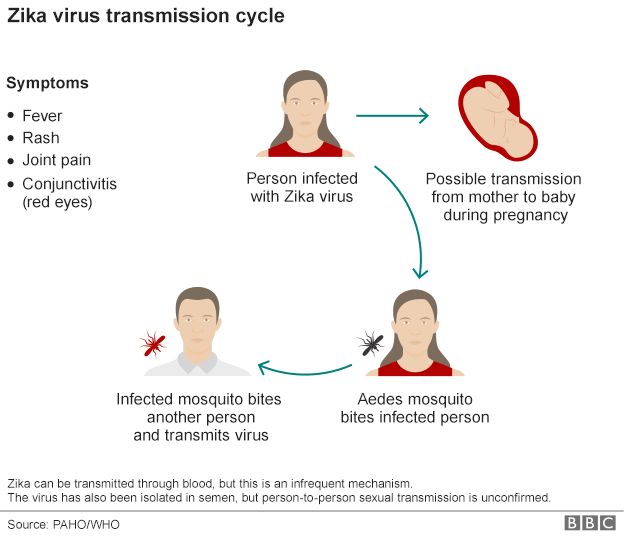
Zika virus is transmitted by daytime-active mosquitoes and has been isolated from a number of species in the genus Aedes, such as A. aegypti, and arboreal mosquitoes such as A. africanus, A. apicoargenteus, A. furcifer, A. hensilli, A. luteocephalus and A. vitattus. Studies show that the extrinsic incubation period in mosquitoes is about 10 days. Zika virus can migrate between humans through sexual contact and it can also cross the placenta, affecting an unborn fetus. A mother already infected with Zika virus near the time of delivery can pass on the virus to her newborn around the time of birth, but this is rare.
Common symptoms of infection with the virus include mild headaches, maculopapular rash, fever, malaise, conjunctivitis, and joint pains. The first well-documented case of Zika virus was described in 1964; it began with a mild headache, and progressed to a maculopapular rash, fever, and back pain. Within two days, the rash started fading, and within three days, the fever resolved and only the rash remained. Thus far, Zika fever has been a relatively mild disease of limited scope, with only one in five persons developing symptoms, with no fatalities, but its true potential as a viral agent of disease is unknown.
In humans, the virus causes a mild illness known as Zika fever, Zika, or Zika disease, which since the 1950s has been known to occur within a narrow equatorial belt from Africa to Asia. In 2014, the virus spread eastward across the Pacific Ocean to French Polynesia, then to Easter Island and in 2015 to Mexico, Central America, the Caribbean, and South America, where the Zika outbreak has reached pandemic levels.


No comments:
Post a Comment